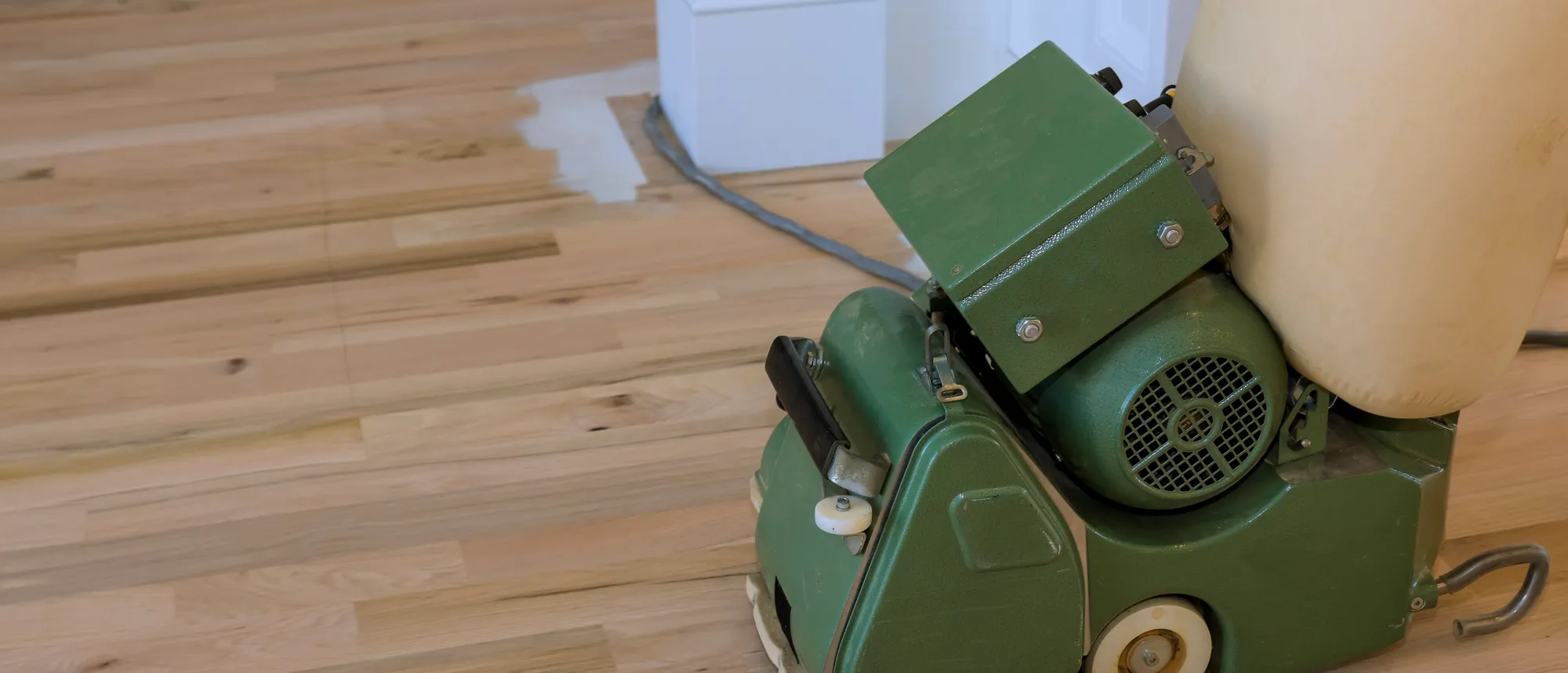
Refinishing, and the dust stays in the machine.
100% dustless sanding and refinishing in San Diego. Rubio Monocoat and Bona, custom color matching, and prefinished floors most contractors decline.
Dust
A sealed vacuum on every machine
Color
Matched and approved on your own floor
Finish
Rubio Monocoat or Bona
On site
Three to six days for 1,000 sq ft
A hardwood floor does not wear out. The finish does.
Under years of scratches, sun fading, pet traffic and furniture, the wood itself is almost always intact. What has failed is the few thousandths of an inch sitting on top of it. Remove that layer properly and you are looking at the same timber that was milled decades ago, usually from trees that are no longer cut the way they were then.
Which is why, for most of the homes we walk into, the floor already there is better than anything available to replace it. Refinishing is not the economical compromise. It is frequently the better floor.


Not every floor should be refinished, and we will tell you which one you have.
On solid hardwood, what matters is how much wood remains above the tongue. A solid floor can typically take several full sandings across its life, and most homes have used one or two. On engineered wood, the question is the thickness of the wear layer above the plywood core: a thick layer refinishes like solid wood, a thin one will not survive a full sanding at all.
There are floors we recommend replacing. Severe cupping from a long-term moisture problem, boards sanded to the fasteners by someone before us, water damage that has travelled through the subfloor. In those cases the honest answer costs us the sanding job and earns the installation, and we would rather have that conversation at the consultation than halfway through the work.

Most floors that look beyond saving are not.
What decides it is how much wood is left above the tongue, and that is a measurement, not an opinion.Every machine is dustless.
Not low-dust. Not plastic sheeting taped across the doorways. Every sander on site, the drum sander, the edger and the corner tool alike, connects to a sealed vacuum system that captures dust at the source, before it reaches the air in your house.
This is the difference people underestimate. Conventional sanding puts fine wood dust into the air of an entire home, where it settles for weeks: on the tops of door frames, inside closets, in the return vents of the HVAC system, and, worst of all, onto a finish that is still curing. Grit that lands in a wet coat is in that floor permanently.
No film on the counters. No cleanup waiting for you. And a finish that is smooth because nothing landed in it.

A beautiful finish begins with careful preparation.
Sanding progresses through a carefully selected sequence of abrasives. The initial pass removes the existing finish and evens the surface. Each finer pass refines the scratch pattern left by the previous one, preparing the wood for a smooth, consistent finish that brings out its natural grain.
Edges and corners receive the same attention as the rest of the floor. We use specialized edging tools and hand sanding to blend these areas into the main surface, creating a uniform appearance throughout the room.
For approximately 1,000 square feet, sanding typically takes two to three days. The floor’s condition, layout, and any necessary repairs affect this stage; the selected finish and its drying and curing requirements determine the remaining schedule.
Sandpaper grit, coarse to fine
Each grit removes the scratch the one before it left. Skip a step and the floor tells on you under the first raking light.
See the full processMatched by hand, against your floor.
Refinishing one room in a house that has hardwood elsewhere is where most jobs fail. The new finish comes out a shade off, and the difference is visible at the threshold for as long as you own the house.
The reason is that a stain color is not a fixed thing. The same mix reads differently on red oak than on white oak, differently on quarter-sawn than on plain-sawn boards, and differently again on wood that has been under sunlight for twenty years and has ambered on its own. A color chart cannot account for any of that, and neither can a sample board finished in someone else's shop.
So we mix and test on your actual floor. We sand a section, apply candidate mixes side by side, let them dry, and look at them in your room, in daylight and under the lights you use at night. You choose standing on the floor, not holding a swatch. Nothing goes on the rest of the room until you have.


Rubio Monocoat and Bona.
Two finishing systems, chosen for different reasons. We will recommend between them based on your house rather than on what is in the van.
Rubio Monocoat
A hardwax oil that sits in the wood.
- Coats
- One
- On site
- Three to four days
- Repair
- A worn area can be re-oiled in place
- Look
- Matte, the grain still reads as wood
Bona
A waterborne film that sits on the wood.
- Coats
- Three to four, screened between
- On site
- Four to six days
- Repair
- Screen and recoat the whole floor
- Look
- More sheen options, a harder surface
Both are specified on the walkthrough, against how the room is actually used. The timings above are for a floor of about 1,000 square feet.

One coat, wiped back. Or three to four, screened between.
The finish you choose sets the calendar, not the sanding.Refinishing prefinished hardwood.
Not every floor should be refinished the same way.
Many prefinished hardwood floors carry an aluminum-oxide factory finish — an exceptionally durable coating built to resist everyday wear. That same durability makes them significantly harder to sand and refinish than a floor finished on site, and it is the reason a lot of contractors decline the job or quietly do it badly.
We bring the specialized knowledge and equipment these floors require. Our process takes into account the existing finish, the construction of the flooring, the remaining wear layer and the condition of the wood before any sanding begins.
Because every refinishing removes a small amount of that wear layer, these floors have a finite number of refinishing opportunities — particularly engineered products with thinner wear layers. Our goal is to spend that opportunity wisely: removing only what is necessary, and preserving as much of the floor's remaining life as possible.
Specialized floors require specialized expertise. That is where SOLUM makes the difference.
Not sure which your floor needs? That is what the walkthrough is for.
Request a ConsultationDamaged boards, replaced and blended.
Water damage under a dishwasher or a planter. Pet staining that has gone through the finish and into the wood. Deep gouges from moving furniture. Cracked or loose boards. A patch left where a wall came out during a remodel. In most homes the damage is confined to a handful of boards while the rest of the floor is entirely sound.
More on board replacement and blending
Replacing a board is the easy half. The blend is the job. It means finding material that matches species, cut, width and thickness, weaving the new boards into the existing run so the seams do not line up in a visible row, and then sanding and finishing the repair into the surrounding floor so that the transition disappears in raking light rather than only head-on.
Two honest limits. On a floor that has aged for decades, new wood of the same species has not been through the same sunlight and will not carry the same tone on day one; it closes much of the gap over the following year, but it is not invisible immediately. And a repair blended into an old finish will always show more than a repair followed by refinishing the whole room. We will tell you which situation you are in at the consultation, with what each option costs, rather than after the work.

A bad board comes out. It does not get covered up.
Cut back to sound wood, matched for species and grain direction, then sanded and finished with the rest of the floor.If the finish is tired but not gone, you may not need a full refinish.
When the wear is in the coating and has not yet reached bare wood, the floor can be abraded lightly and given a fresh coat, without sanding back to raw timber. It is a fraction of the cost, it is usually a one-day job, it puts no wear on the thickness of the floor, and it resets the surface for years.
More on when a recoat is enough
The catch is timing. Once traffic has worn through to the wood, that window has closed and a full refinish is the only option. A quick test at home: put a drop of water on the worn path. If it beads, the finish is still doing its job and a recoat will work. If it darkens the wood within a few minutes, the coating is gone there.
We will recommend a recoat when a recoat is what your floor needs. It is the smaller job, and telling you so is how we end up doing the larger one later.
The finish you choose sets the calendar.
For about 1,000 square feet:
More on what changes the calendar
With Rubio Monocoat — three to four days on site, depending on how much the sanding demands. Sanding takes two to three days, cleaning and preparation about half a day, and the application one full day: a single coat, but 1,000 square feet takes the whole day to buff properly and wipe the excess off on time.
With Bona — four to six days. The same sanding and preparation, then three to four coats, each one screened before the next so the layers bond, with drying time in between that cannot be compressed.
Then the floor cures on its own timetable. Walk on it carefully in socks after 24 hours. Furniture after three days, moved rather than dragged, ideally with felt under the legs. We will tell you when rugs can go back down, since that depends on the system.
Stairs, extensive board replacement, prefinished floors and removing an old solvent-based finish all add days. Whatever your floor needs, the number of days comes in writing with the quote, and if we find something under the old finish that changes it, you hear that the day we find it.
We generally recommend being away during the work, and dust is not the reason. A floor that is not walked on cures evenly and finishes faster. For a single room or a phased project, staying is usually straightforward.
For about 1,000 square feet. Stairs, board replacement and stripping an old solvent finish all add days, and the quote says how many.

Send a photo of your floor.
We can usually tell from one image whether it needs refinishing or replacing.